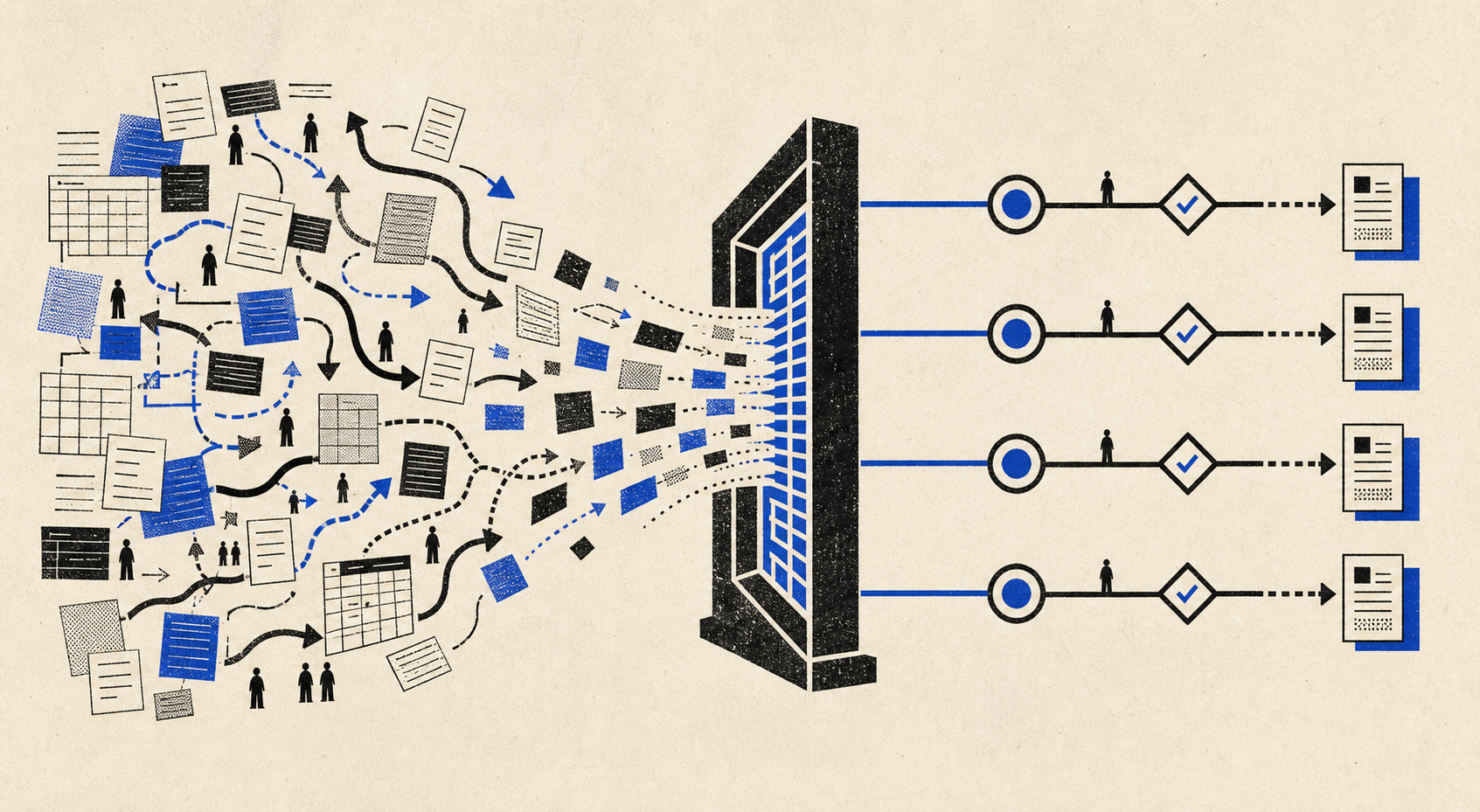
Process software should remove work.
Most employees do not want a ticket. They want access granted, a vendor onboarded, a purchase approved or an exception resolved. The ticket is only the record of movement toward that outcome.
Orchestra starts from that distinction. It treats process as an organizational operating layer rather than an inbox. AI helps describe, inspect and simplify the process; the governed runtime decides what may execute, who may see the data and what becomes part of the audit record.
This makes the intelligence layer useful without making it sovereign. Models can change. The process definition, policy boundary, execution history and system of record remain under the organization’s control.
Coordination debt is the real problem.
Processes accumulate steps because a previous tool required them, a handoff once failed, or a spreadsheet became unofficial policy. The result is not merely poor user experience. It is additional cycle time, duplicated data, unclear ownership and work that falls between systems.
- What the employee asks
- “Can this vendor be ready for the next purchasing cycle?”
- What the stack returns
- A portal, a form, several queues and no single view of the outcome.
- What management loses
- The reason for delay, the cost of each handoff and the evidence needed to redesign the work.
One process demonstrates the whole system.
Consider vendor onboarding. The requester answers material questions; Orchestra turns those answers into a governed process and carries the vendor context through every branch.
-
Describe the outcome.
AI asks only what changes the process: vendor type, data exposure, spend and required date.
-
Split work without losing context.
Legal, security and finance receive separate branch tickets with their own owners and deadlines.
-
Execute through governed systems.
Approved data is written to a table; procurement is triggered; exceptions return to the right owner.
-
Learn from completed cases.
Cycle time and handoff evidence show which questions, approvals and waits should remain.
A deliberately small process kernel.
Human work is expressed through two primitives. Everything deterministic becomes a system step. This is not a claim that enterprise work is simple; it is a constraint that prevents incidental complexity from becoming product architecture.
- Task
- A person produces or verifies work. Human primitive
- Approval
- A person makes an accountable decision. Human primitive
- System actions
- Decision, parallel, wait, data, service, notification, subprocess and bounded AI. Typed engine steps
- Composition
- Processes call processes; branches create separately owned tickets; tables carry governed state. Process graph
AI has context, not authority.
The model does not receive database credentials, user tokens or publish authority. It receives filtered context and returns typed proposals or outputs. The governed platform validates and executes them.
Describe an outcome, complete a Task, make an Approval and inspect the record.
Draft, classify, extract, summarize and recommend from explicitly supplied context.
Validate definitions, enforce access, orchestrate durable execution and write the audit trail.
Tickets, process state, tables, files, identities, integrations and evidence-linked memory.
Memory is a product behavior, not a vector database.
A vector index can make evidence retrievable, but it is not the source of truth or the moat. Useful organizational memory must remain linked to the originating ticket, filtered by the viewer’s permissions, and subject to retention and deletion rules.
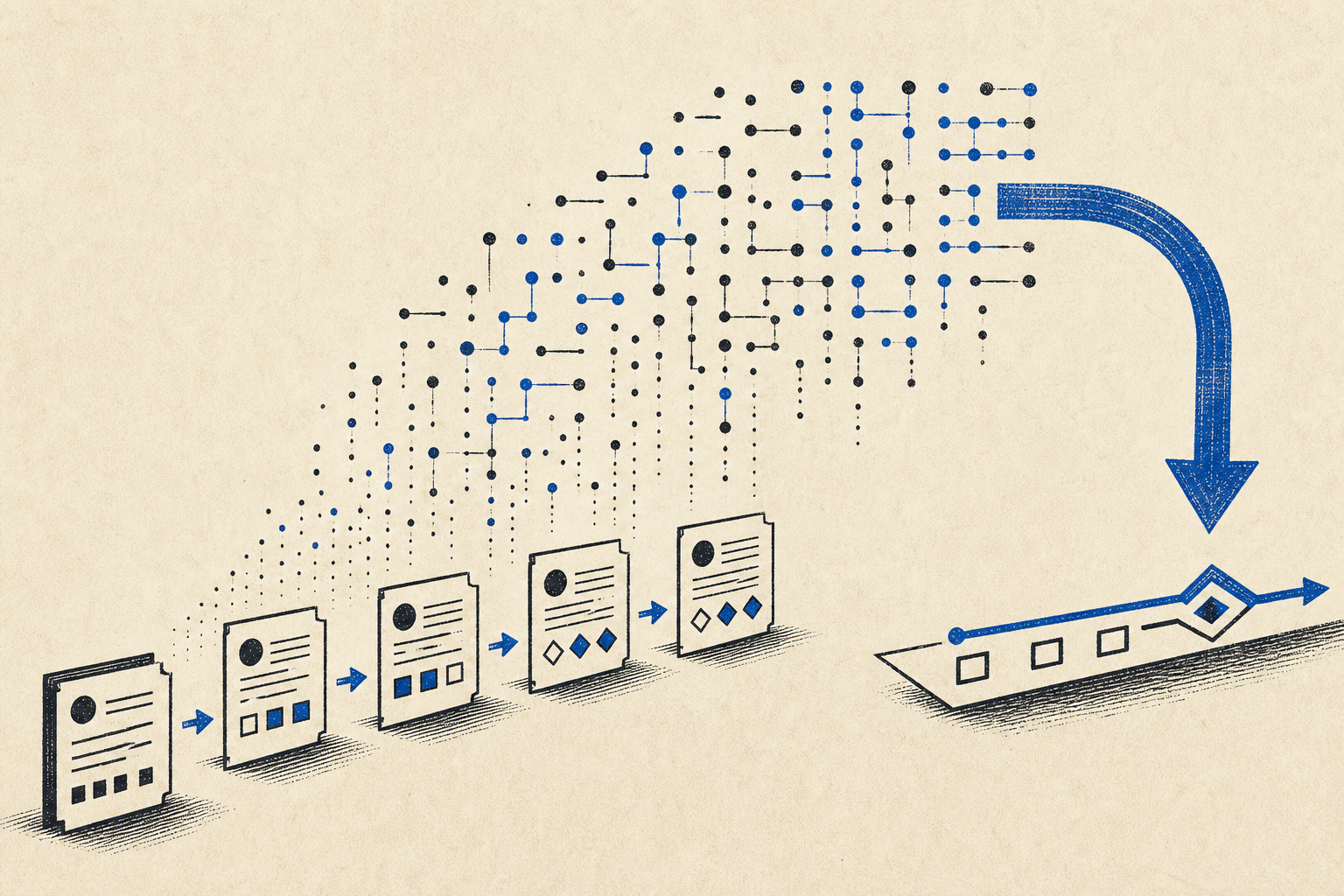
The optimization target is fewer necessary steps. Orchestra should surface where work waits, why a decision exists and whether a branch produces an outcome worth its cost. First-principles reasoning and KISS are therefore measurable product behavior, not slogans.
Land on one costly process.
The economic buyer already funds workflow, service management, automation and operational reporting. Orchestra should not begin by asking that buyer to replace an estate. It should enter through one process with visible ticket volume, handoff cost and an accountable owner.
- Beachhead
- Vendor onboarding, access, exceptions or another process with clear ownership and repeat volume.
- Initial value
- Faster process publication, fewer human touches and shorter median completion time.
- Expansion
- More processes, integrations, execution volume and evidence-backed intelligence surfaces.
The distinction is architectural.
Established workflow, service-management and automation platforms already offer AI, governance and process analytics. Orchestra should not claim those ingredients are unique. Its argument is that they are composed differently.
- Small kernel
- Two human primitives and typed system actions keep authoring and execution legible.
- One control path
- AI proposals, human work and system actions pass through the same governed runtime.
- Execution evidence
- The ticket is a process-native record that can improve the next version without becoming an ungoverned data copy.
Product truth before traction theater.
The process control plane is substantial. The intelligence plane is earlier. Keeping those two facts visible is more credible than converting roadmap into present-tense marketing.
Flow 2.0 authoring, versioned processes and forms, tenant isolation, OIDC, process access and audit.
Tickets, Task and Approval, system elements, durable Temporal execution, tables and integrations.
Flow Copilot proposals with explicit apply/discard and bounded runtime Ask-AI evaluation.
Blank-slate interview authoring, analysis of existing process friction and employee intent routing.
Evidence-linked ticket memory, leadership patterns and complete-task AI inside explicit policy.
Prove the wedge with operating evidence.
A design partner should choose one process, run real cases and agree on a baseline before rollout. The proof is not feature adoption. It is whether work moves with fewer necessary interventions.
- Time to first published process
- Metric to confirm
- Human touches per completed case
- Metric to confirm
- Median end-to-end cycle time
- Metric to confirm
- AI proposals accepted or rejected
- Metric to confirm
- Policy violations prevented
- Metric to confirm
The compounding asset is governed evidence.
More completed cases create better evidence. Better evidence reveals removable steps and improves process proposals. Better processes create more usage. That loop compounds only if the evidence remains permission-aware and tied to execution.
Models are replaceable. A trustworthy history of how work moved, why decisions were made and which process versions produced better outcomes is harder to reproduce.
The risks are product risks, not footnotes.
-
Complexity returns.
Counter it by measuring nodes, questions, human touches and time to publish, not by adding another abstraction.
-
AI claims outrun delivery.
Keep proposals explicit, label roadmap in the same view and never imply that memory or autonomy ships before it does.
-
Incumbents bundle aggressively.
Enter through a narrow process, integrate with the estate and prove operating value before asking for platform expansion.
-
Memory has insufficient evidence.
Choose design partners with repeat case volume and preserve the source, permission and retention contract from the first pilot.
Capital converts a control plane into operating proof.
The next financing should fund the intelligence plane, a secure pilot package and enough design partner volume to establish repeatable economics.
Describe the outcome. Govern the execution. Improve the next case.